


*Editors Note: there will be no Blog next Monday due to the upcoming holiday weekend.
All many people wanted for Christmas was the NVIDIA’s^ third quarter earnings to reaffirm the AI bull run. And from a fundamental’s perspective, Santa came early this year.
Shares of the leading chip juggernaut rallied as much as 6.5% after the bell last Wednesday. They then opened the following morning up about 5% before giving some gains back with the rest of the market later that day.
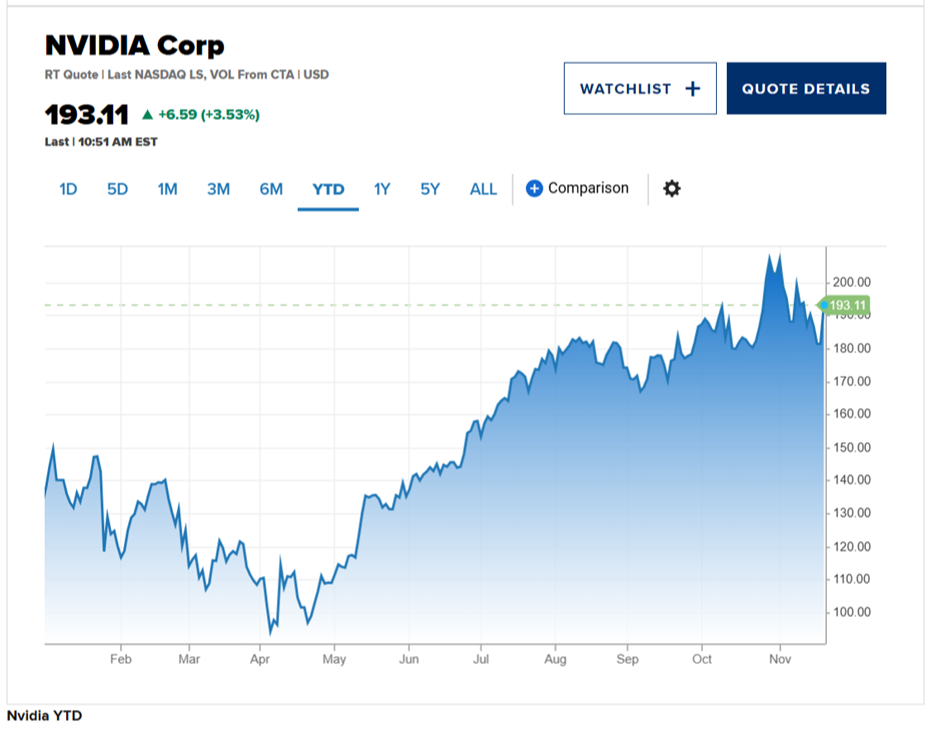
For perspective on NVIDIA's earnings, the company reported third quarter sales of over $57 billion, which is a 62% gain over a year ago and beat expectations. Per-share earnings increased 67% to $1.30. The company also upped guidance for fourth quarter revenue to $65 billion.
These results are important because they beat consensus expectations and the “whisper number.” This is what the buy side (e.g., hedge funds, asset management firms, pension funds, etc.) is believed to want (the investors actually risking money).
When a company announces an earnings beat but its shares drop, it’s often because the “whisper number” wasn’t hit. That didn’t happen with NVIDIA, as evidenced by its big gains when earnings were announced and for much of the following trading day before a market-wide downturn.
The next big task is whether NVIDIA’s earnings can revive the broader technology trade (which it began to appear to do beginning last Friday and continuing into today’s market open). That would put a pin in the bubble of those questioning if there's an AI bubble. NVIDIA’s earnings at the very least should help quell a lot of the naysayers.
The results might even be enough for investors to overlook the late release of the September jobs report due to the government shutdown.
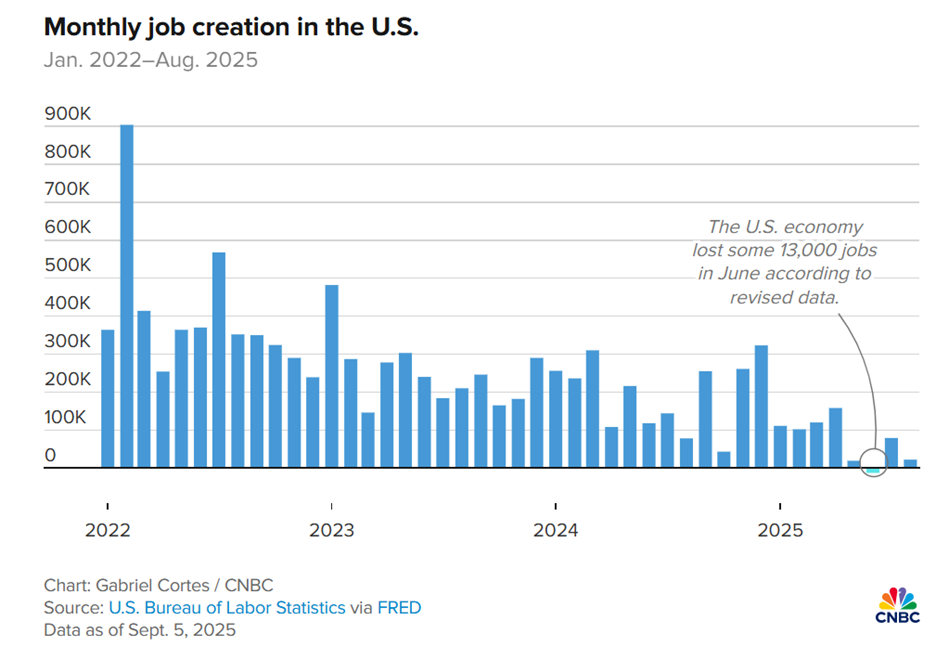
The earnings figures could even make up for any concern over whether delayed data will cause the Federal Reserve to skip a December interest rate cut.
A further countering of the AI bubble was NVIDIA CEO Jensen Huang announcing a deal with Saudi Arabia to “build supercomputers that will control quantum computers and power their compute-heavy error correction systems.” That coincided with Elon Musk’s additional announcement that xAI will work with Saudi Arabia's sovereign wealth fund and its AI arm HUMAIN on a new data center with NVIDIA’s Blackwell chips.
Clearly the global AI infrastructure buildout is still young. The optimist in me finds the recent market volatility interesting because NVIDIA shares look even more attractive from a valuation perspective at only 29.3 times forward earnings versus Walmart’s 35X.
Earnings and Institutions
NVIDIA’s results capped earnings season. The all-important blended net profit margin for the S&P 500* for Q3 2025 is 13.1%:
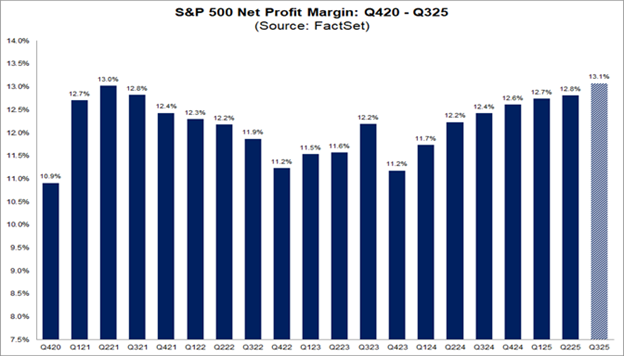
It’s the highest net profit margin reported by the S&P 500 going back to at least 2009, when FactSet’s data starts (the previous high was 13.0% in 2021). It’s also the seventh consecutive quarterly increase in the net profit margin.
At the sector level, the profit increase was led by technology (2.6% above expectations), utilities (2.4%), and financials (3.2%):
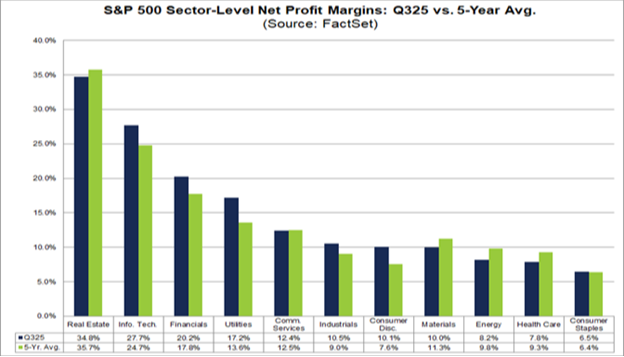
Also, analysts now believe net profit margins will be even higher with Q4 2025 at 12.8%, Q1 2026 at 13.3%, and Q2 2026 at 13.7%.
So, when will the current selloff end?
The good news is that most of the damage seems done. Strong corporate earnings indicate the end of capitulation should be near, bringing a new floor.
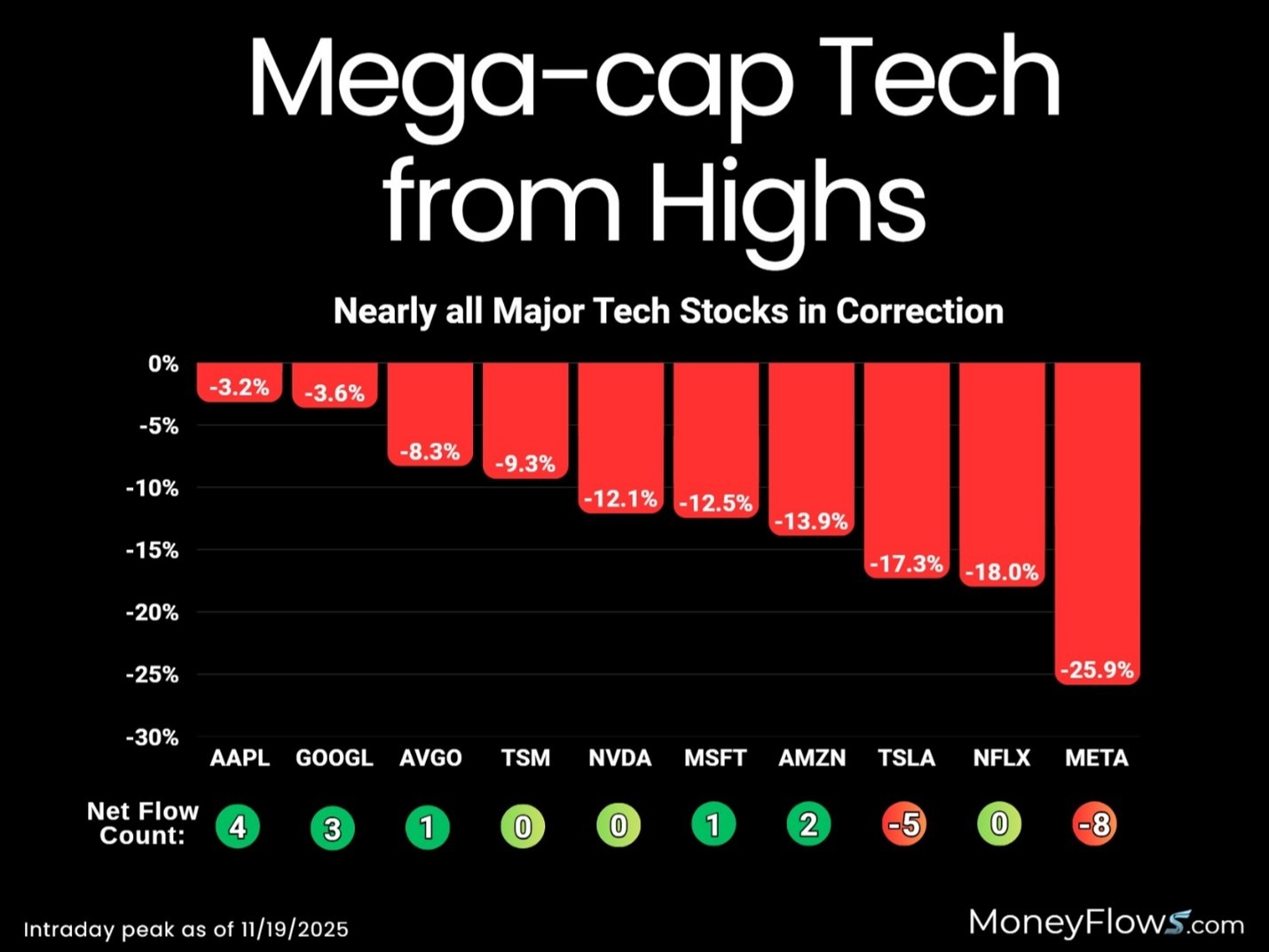
This volatility perhaps felt worse because the AI bubble narrative joined with the “Magnificent 7.” Despite these stocks’ market-lifting ability, they’ve suffered too:
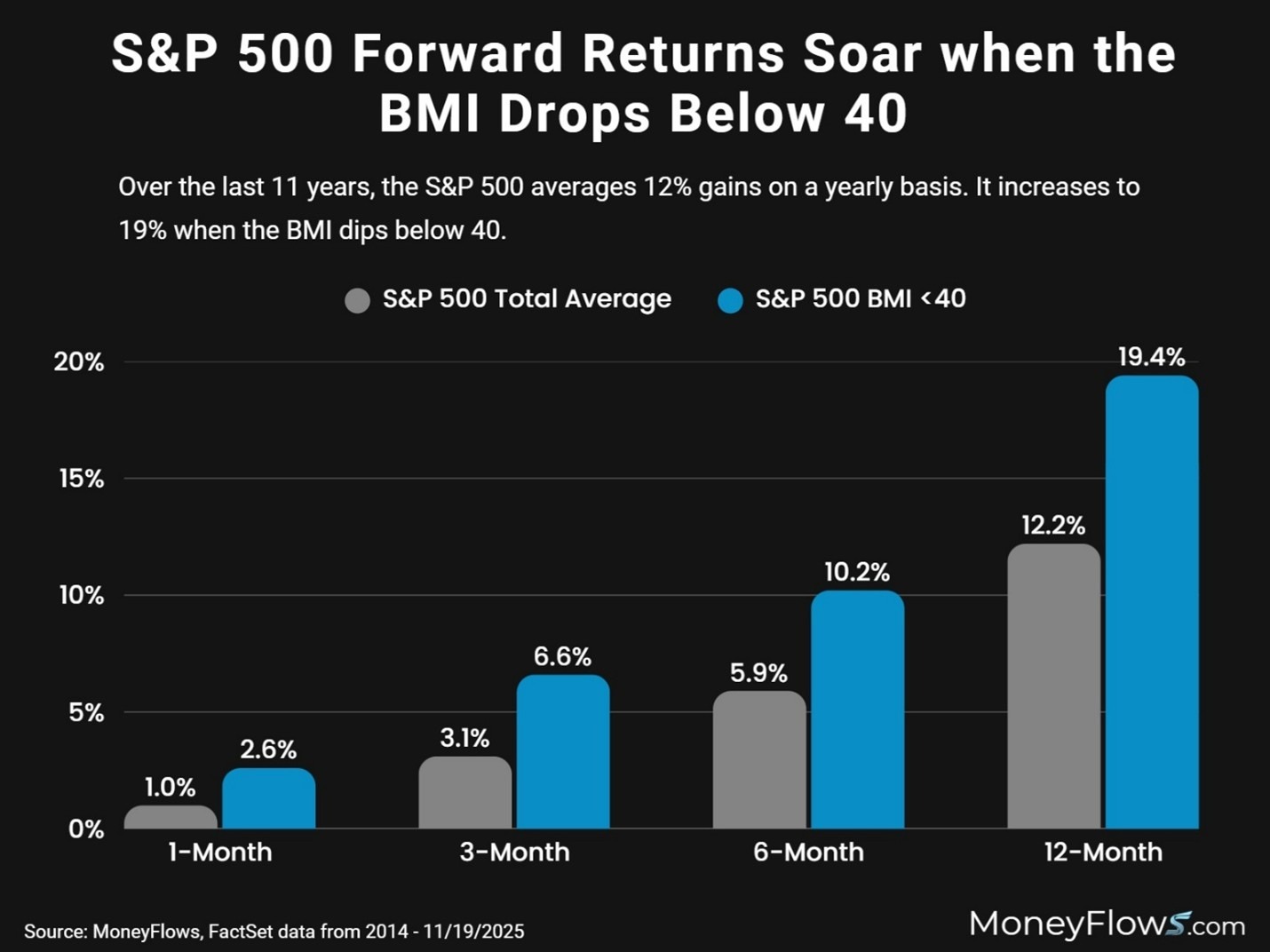
But our experience suggests we can be constructive on stocks once the Big Money Index (BMI) from MoneyFlows approaches 40% (it’s currently at 46% after the market caught a bid last Friday).
The BMI is a 25-day moving average of “big money” investor activity. It’s often a bellwether for market activity and trends. When the BMI drops below 40%, average returns nearly double:
These events coincide with being able to spot capitulation. We define capitulation as roughly 400 equity outflows in a single session (nearly 30% of the institutionally traded universe). That often signals a near-term bottom, from which markets tend to race higher:
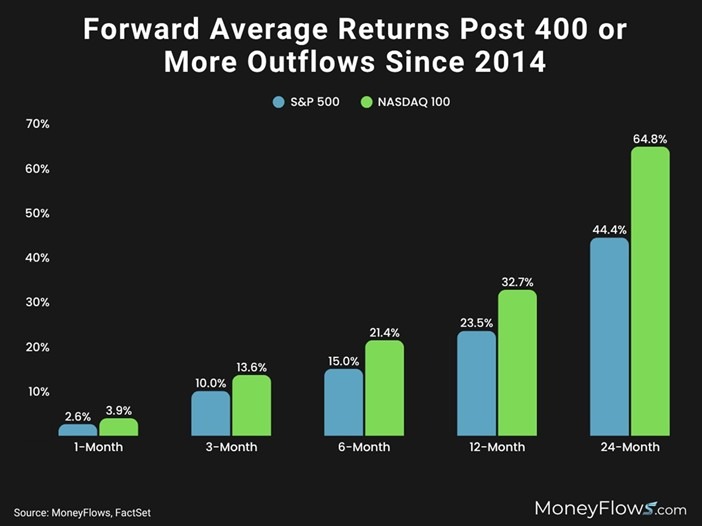
Capitulation doesn’t feel good. But the data currently aligns with previous market resets over the last 10 and 20 years. In many ways, we’ve been here before.
Our Favorite Investment Theme
Markets rotate to send stocks up and down over time as strategies shift in and out of favor. As such, it's time for us to reinforce our favorite investment theme: dividend growth equity investing.
These types of stocks constantly compound, even in the face of narrative-driven volatility. You may have heard investing legend Warren Buffett describe dividend growers as the secret sauce to monster gains.
We agree. And now is a perfect time to hunt for value-driven dividend growth stocks.
One reason is the Fed cutting interest rates. Even if it skips December, more cuts are on the way.
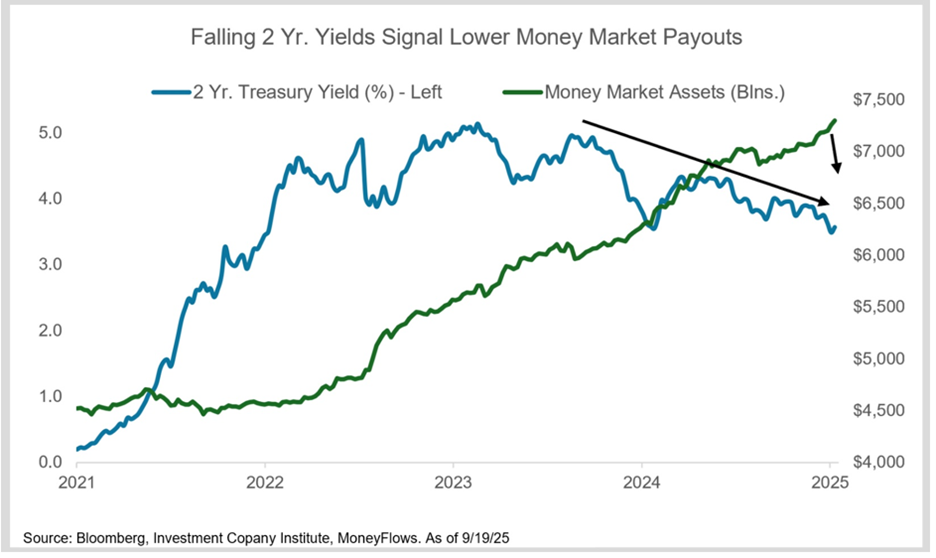
At last count, $7.5 trillion sits in money market accounts. But it’s no longer 5%. Now it’s getting 3.5%, making money markets much less attractive.
Dividend investments have stood the test of time, being a massive part of the S&P 500’s total return for decades:
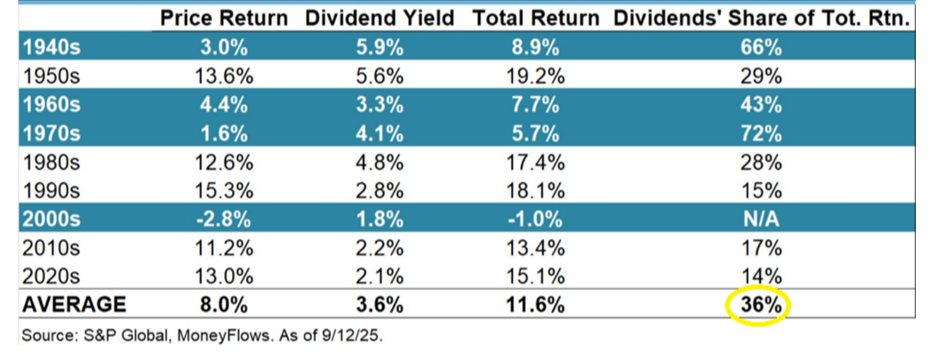
This is why dividends are a core tenant of our overall client portfolio allocation strategy. Since the 1940s, dividends are responsible for over a third of the market's total return. In our minds, it seems crazy to try investing without them.
Markets don't go up in a straight line. Sometimes stocks correct. This is where dividend stocks offer an edge and why they’re our foundational “secret sauce.”
For example, since 1975, when the S&P 500 experiences a correction of 10% or more, dividend paying stocks outperform the S&P 500 equal weight index by 5.5%:
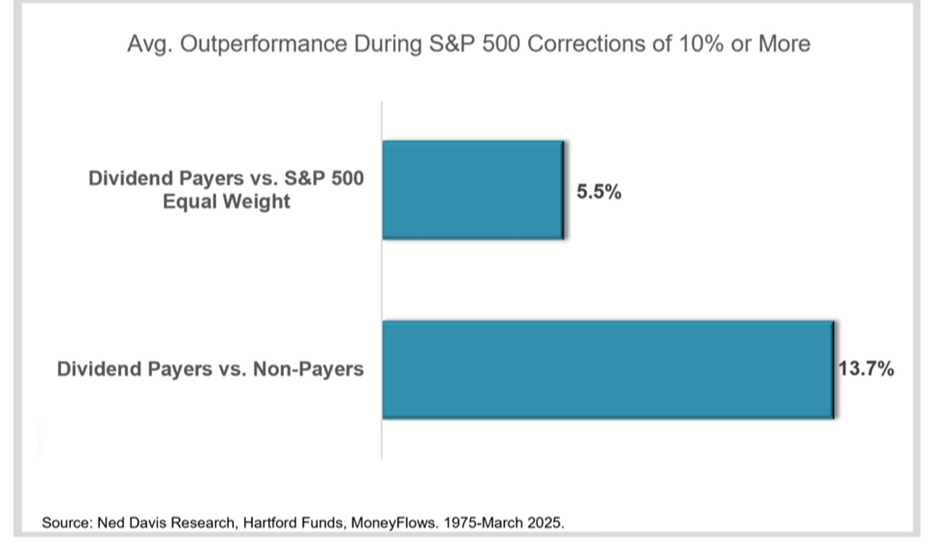
Even better, dividend payers destroy non-dividend payers by a whopping 13.7% during heightened volatility.
You cannot afford to not own dividend stocks. The Holy Grail of investing is owning high growth stocks that increase their payouts every year.
Every day we track movements on thousands of stocks. Over the past six trading days of volatility there’s been a significant onslaught of inflows into dividend growth areas like health care, financials, and energy:
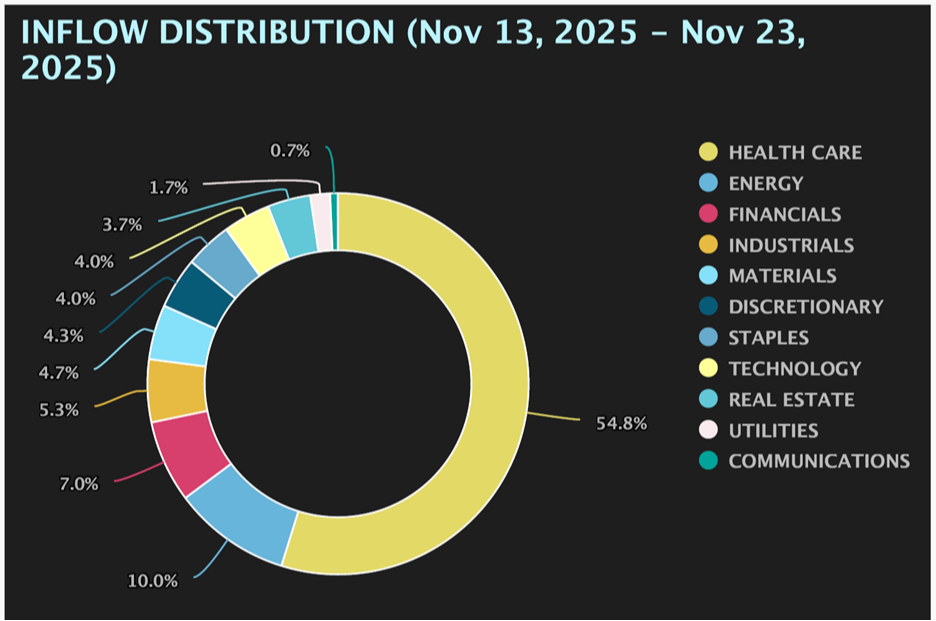
These groups sport dividend yields of 1.611%, 1.4%, and 3.23%, respectively, and comparatively tower over the S&P 500's current yield of 1.09%.
Many new investors focus on high, unsustainable yields for dividend stocks. That’s a fool's errand.
Instead, isolate companies with growing businesses, earnings, low payout ratios, and ever-growing dividend payouts. We try to focus on payout ratios below 40%. This allows room for management to increase payouts even in tough times.
That’s how to keep their investors fat and happy.
“When I choose to see the good in things, I'm not being naive. It is strategic and necessary. It's how I've learned to survive through everything.” – Waymond Wang (from “Everything Everywhere All at Once”)
* Links to third-party websites are being provided for informational purposes only. CoreCap is not affiliated with and does not endorse, authorize, or sponsor any of the listed websites or their respective sponsors. CoreCap is not responsible for the content of any third-party website or the collection or use of information regarding any websites users and/or members.
*Past performance does not guarantee future results.
*Investing involves risk and you may incur a profit or loss regardless of strategy selected.
^ Nvidia is owned in Cornerstone client accounts and by Daniel Milan personally.
* The S&P 500 is an unmanaged index of 500 widely held stocks that is generally considered representative of the U.S. stock market.
Securities sold through CoreCap Investments, LLC. Advisory services offered by CoreCap Advisors, LLC. Cornerstone Financial and CoreCap are separate and unaffiliated entities.