


Last week, we at Cornerstone made the case that the post-midterm selloff was an emotional reaction rather than one based on objective fundamentals and any potential policy shock can’t stop what’s already in motion. The natural follow-up this week is to further detail what’s happening and why it matters to the overall AI infrastructure build-out trade.
Today's analysis provides the necessary clarity that the current AI capital expenditure cycle is fundamentally supported by what has already been spent, built, contracted, and ordered. It doesn’t depend on a single data center that hasn't been announced or any forecast that hasn't yet come true.
To objectively test this theory, we must climb a ladder of evidence from the most certain rung to the least. Most importantly, this analysis deliberately refuses to rely on anything disclosed but not yet under construction.
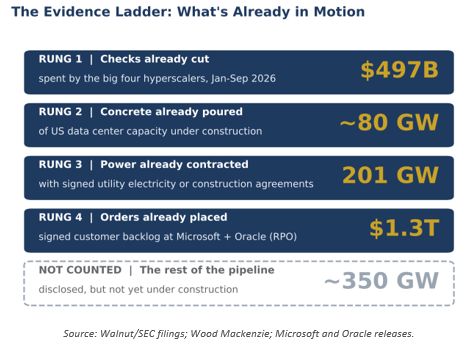
Rung One – Checks Cut
Let’s start with a clear, objective data point – cash that’s already spent. For example, Microsoft, Alphabet, Amazon, and Meta combined have spent $201.9 billion on property and equipment in the third quarter alone:
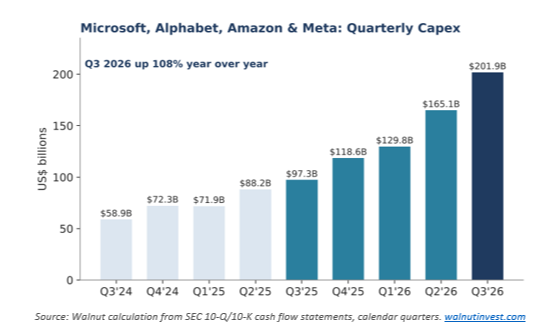
That figure is up over 100% from the year prior, and the growth rate has risen each of the last three quarters.
Zooming out, those four companies spent $496.7 billion in the first nine months of 2026. That’s already more than they spent in 2025.
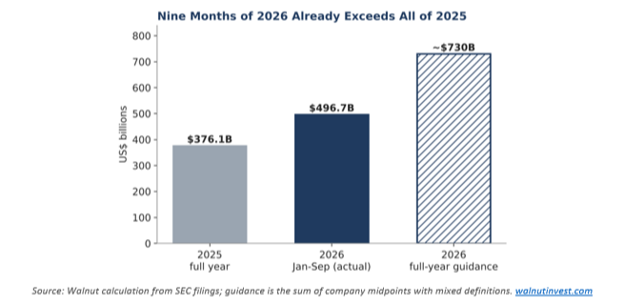
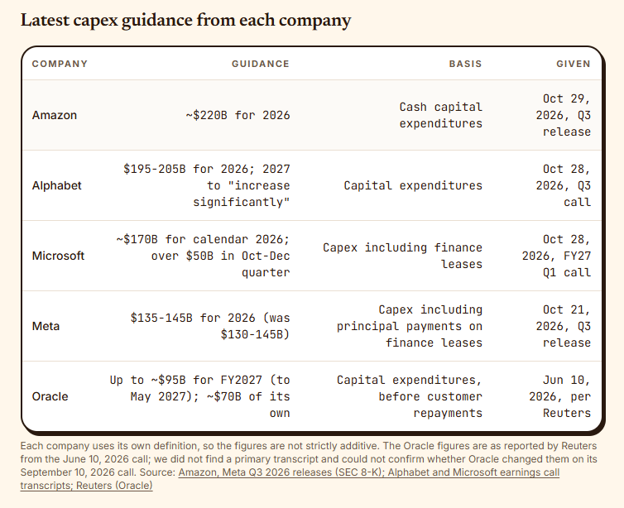
To be clear, these numbers are from SEC filings, not press releases or aspirations. The latest earnings calls made clear how management at these companies sees no slowdown in the foreseeable future. Every significant hyperscaler has reiterated forward-looking capital expenditure guidance:
Rung Two – Concrete Poured
Money dedicated to a project is one objective measure. Shovels, steel, and concrete in the ground is another.
Nearly 80 gigawatts of data center capacity is being built, which is almost double the figure at the end of just this year’s first quarter.
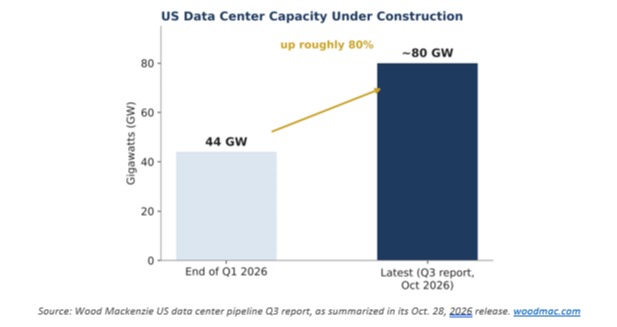
While impressively significant on its own, some independent trackers think the actual construction underway is even higher than reported data. For example, SemiAnalysis argues current construction capacity estimates are low based on satellite imagery analysis.
So, there could be unreported upside on top of what we're laying out. That said, we’re sticking with conservative, objective data for this analysis.
Additionally, there’s been a significant increase in the development of U.S. gas power capacity, which was up 50% in the first half of 2026 alone:
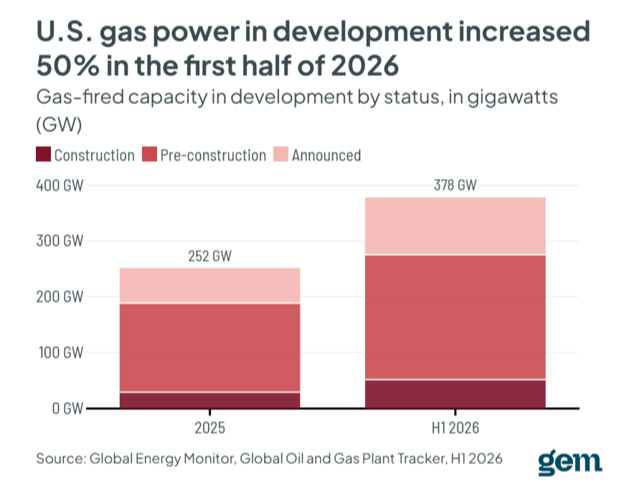
This gas power data is vitally important to understanding the viability of data centers under construction. As we know, having the energy necessary to feed these campuses is as important as the steel, concrete, and chip infrastructure themselves.
For perspective, the all-in cost of a one-gigawatt AI facility is roughly $50 billion, per former Nvidia CEO Jensen Huang’s recent keynote. That includes land, power, building, compute, networking, cooling, and more.
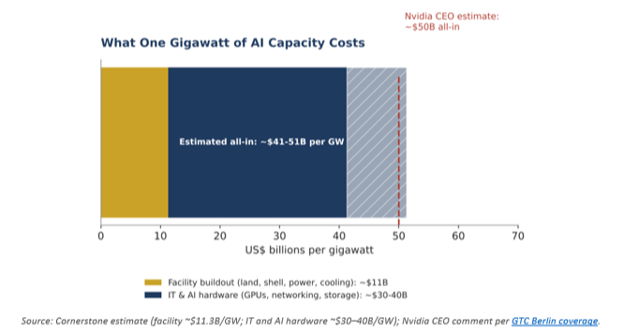
At that range, we can calculate the capacity currently under construction represents roughly $3.3 trillion to $4.1 trillion of total capital expenditure being injected into the overall economy.
It hasn't all been spent yet. But we think this shows the impressive scale of construction already underway, isn’t stopping and the huge economic activity being generated.
Rung Three – Signed Power Agreements
In addition to the pledged funding and expenses, Wood Mackenzie reports an additional 201 gigawatts of capacity is committed via electricity service construction agreements with utilities.
These agreements matter and are a much higher bar than mere interest or intent. After all, a data center without electricity is just an expensive warehouse.
Power availability remains a near-term constraint on the pace of the build-out. So, signed agreements in place for such a significant amount of capacity brings a much higher level of confidence in those planned projects’ viability.
Frankly, it gets the biggest potential roadblock seemingly out of the way.
Rung Four – Orders Placed
Lastly, and maybe most importantly, let’s understand the magnitude of what’s already in motion and not in jeopardy of being reversed. In other words, let’s examine the orders already in place.
First and foremost, last week's earnings announcements from Nvidia provided significant clarity in support of the overall AI infrastructure and data center ecosystem’s health. Nvidia’s data center revenue reached over $107 billion dollars:
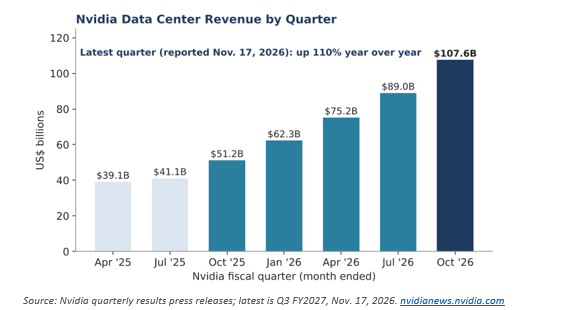
That’s up 105% year-over-year, and the company now has over $518 billion in future purchase commitments (up from $279 billion the previous quarter).
But it goes beyond Nvidia. We can see the same strength in revenue and growth from Microsoft and Oracle.
Microsoft's commercial backlog of contracted unrecognized revenue, which rose 73% to $677 billion:
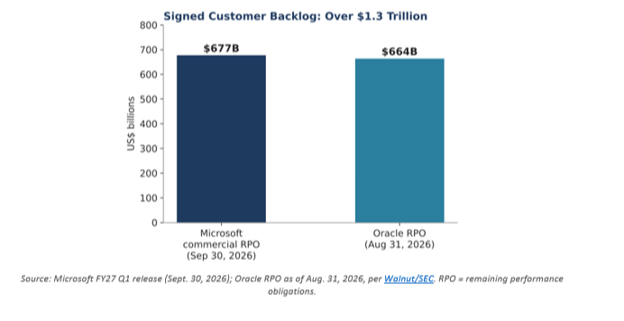
Notice Oracle also reported a similar backlog of $664 billion in revenue.
In just those two companies, that's more than $1.3 trillion of unrecognized revenue from signed customer commitments.
As great as this fundamental data is, notice what’s missing – the rest of the pipeline that’s been publicly disclosed but not yet constructed. According to Wood Mackenzie, that amounts to an additional 350 gigawatts of U.S. capacity.
But imagine the unthinkable happened and not a single gigawatt of those 350 not yet under construction was completed. Even if that happened, the capacity buildout train that’s already left the station is sufficient on its own to support continued growth of the AI infrastructure ecosystem.
*Links to third-party websites are being provided for informational purposes only. CoreCap is not affiliated with and does not endorse, authorize, or sponsor any of the listed websites or their respective sponsors. CoreCap is not responsible for the content of any third-party website or the collection or use of information regarding any websites users and/or members.
*Past performance does not guarantee future results.
Securities sold through CoreCap Investments, LLC. Advisory services offered by CoreCap Advisors, LLC. Cornerstone Financial and CoreCap are separate and unaffiliated entities.