


There was a material stock market decline two days after the midterm elections, where the S&P 500 fell 4.4% and the Nasdaq 100 dropped 6.5%. Behind those massive declines was a multitude of factors that deserve our attention and analysis.
Not to announce today’s verdict before showing the analysis, but at the end of the day, we at Cornerstone firmly believe the AI structural story remains intact based on the current objective, unemotional data. These are the times U.S. corporations have repeatedly shown they’ll turn crisis into opportunity.
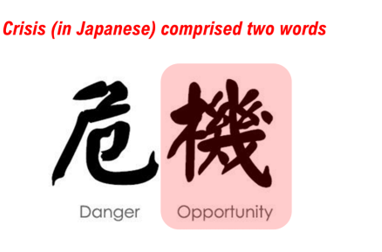
As we parse this landscape, we’re reminded of how the Japanese word for crisis (ke-ke) is comprised of two characters, one meaning danger and one meaning opportunity:
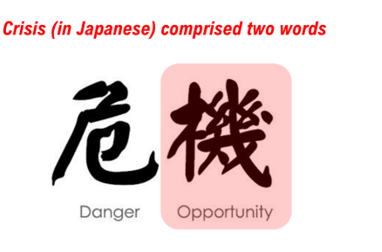
The decision to make in this environment is whether investors will focus on danger or chase opportunity in this current “crisis”. In our experience, many investors tend to focus on danger in a crisis. But we believe the post midterm selloff instead presents itself as a strong opportunity.
To understand this, let’s first understand the “danger” that developed following the midterms. It was a trifecta of shocks around policy, visibility, and liquidity (along with the quick, unexpected resignation of Nvidia CEO Jensen Huang):
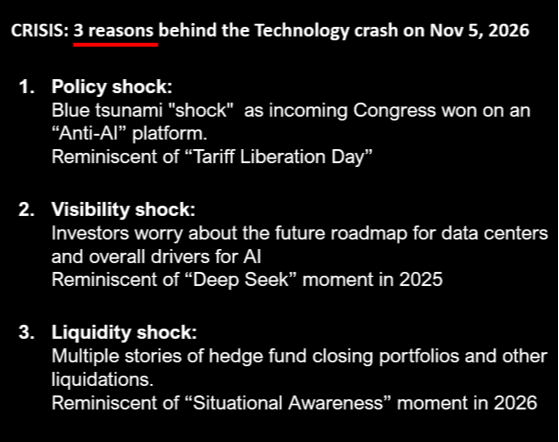
There’s a “blue tsunami” of incoming politicians that partially campaigned on an anti-AI platform. Many incoming governors and members of Congress spoke of AI data center moratoriums.
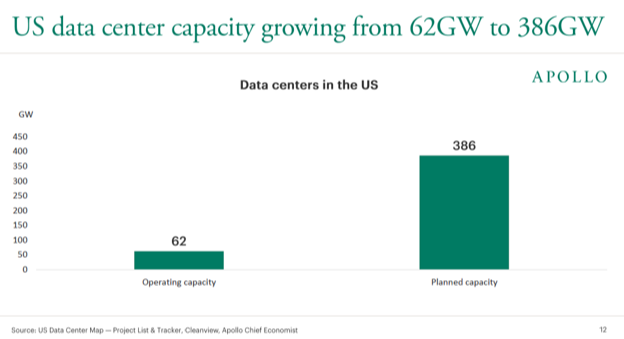
But even if the unthinkable happened – a full, government-led pause of any additional AI data center builds – it can’t stop what’s already in motion. That includes 386 gigawatts of planned capacity over the next three years on a train that has already left the station:
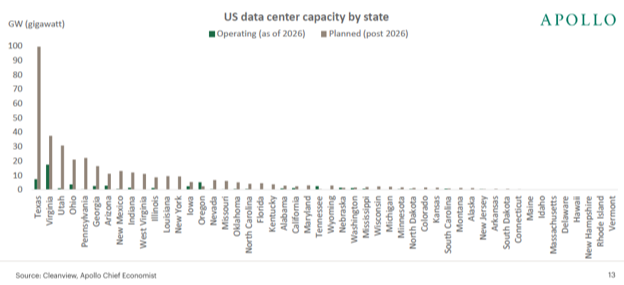
Additionally, most data center decisions and approvals are made at the state level rather than there currently being any federal involvement. There’s already a clear delineation between the states embracing data center builds versus those that are not, which has been plenty to accommodate the current buildout requests:
Turning to the second assumed danger, the visibility shock, investors are increasingly worried about the data center roadmap and AI’s overall drivers. Frankly, this reminds us of how investors panicked in early 2025 over semiconductors, and Nvidia specifically, after DeepSeek significantly reduced AI’s computational needs.
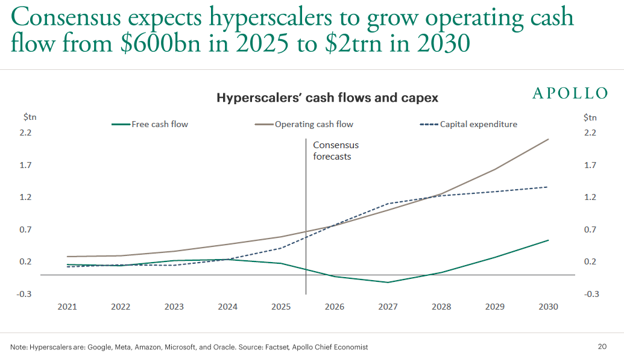
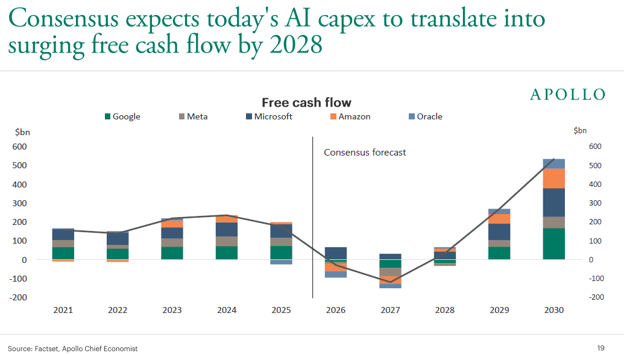
In our opinion, this visibility fear diminishes once you understand the magnitude of the expected growth in operating cash flow for the companies making massive capital expenditures purely based on the data centers up and running or already planned. Operating cash flow for these companies is expected to more than triple to over $2 trillion by 2030:
Finally, regarding the liquidity shock, many investors emotionally reacted in the face of significant, quick market declines. But as always, with more information the picture gets clearer.
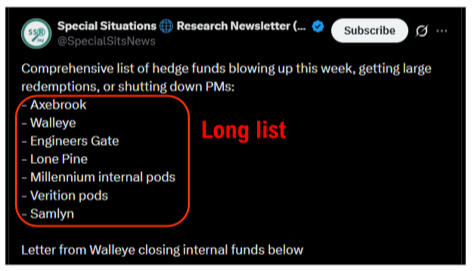
In this case, we now know there were “big money,” institutional liquidations due to a significant list of hedge funds closing via forced redemptions:
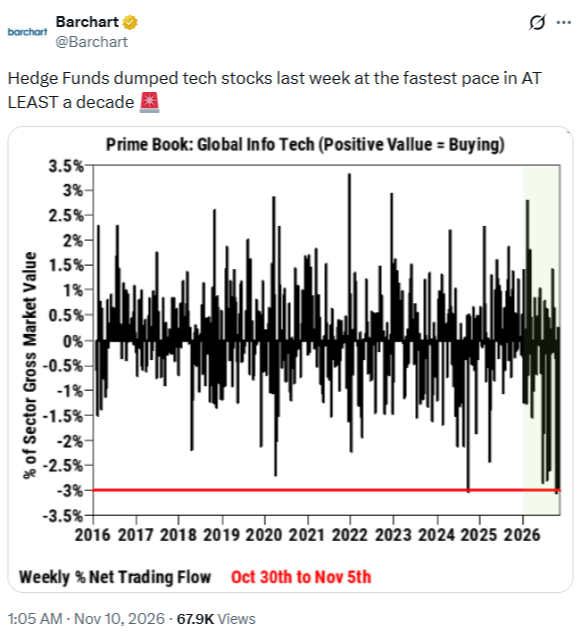
This caused significant selling pressure, especially within the technology sector, as these hedge funds sold off their technology portfolios at the fastest pace in at least a decade:
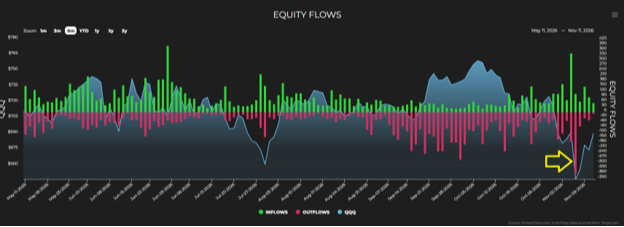
Also, our institutional equity flows data reflects the same levels of significant one day outlier outflows from two Thursdays ago:
But emotional panics are nothing new. This one-day selling pressure had an eerily similar underlying pattern to the “crises” with DeepSeek in 2025, the April tariff volatility, and the July Situational Awareness hedge fund liquidity crash.
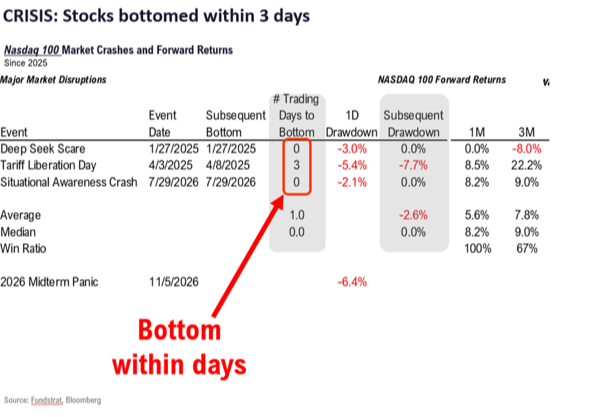
But after each of these shocks, equities bottomed immediately or shortly after the initial panic. And a quick bottoming seems to have played out once again after immediate bounce on Friday and the subsequent week of trading after Thursday's panic.
Focus on the Opportunity
So, if the objective data tells us that this recent “danger” was emotional and not fundamentally driven, we can focus on the opportunity rather than any danger. To be clear, the opportunity thesis is that the AI structural story remains intact.
To fully analyze this hypothesis, let’s examine the four key elements to AI – demand, supply, speed, and net present value:
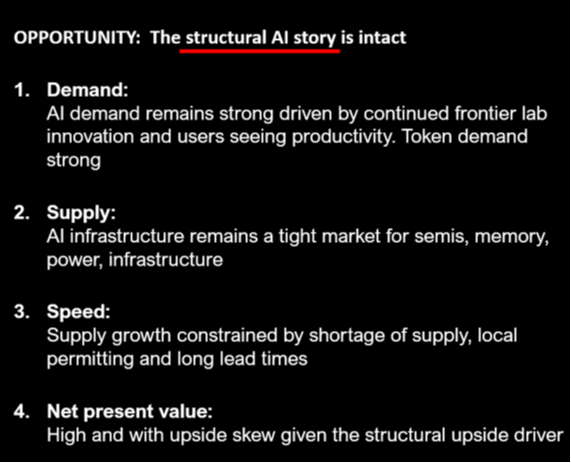
Starting with AI demand, we know it’s strong and accelerating due to evidence of users experiencing productivity gains. That’s already being realized in hyperscalers’ data center and cloud revenue growth.
These early returns indicate U.S. corporations are already seeing benefits and productivity gains from AI, so they’ll continue to increase their usage and use cases.
Next, AI infrastructure supply remains historically tight for everything:
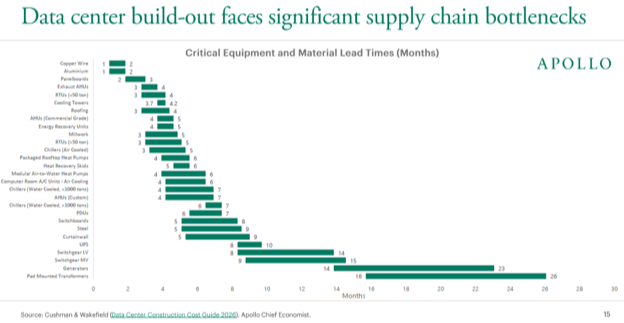
The data center buildout already faces significant supply chain bottlenecks across all infrastructure layers, which as earnings reports have shown, are extraordinarily beneficial to these corporation's bottom line, earnings, profits, and revenue growth.
Next, deployment speed is one of the biggest headwinds for data center buildouts, delaying profitability through supply shortages, local permitting hurdles, and long lead times. Delays, regardless of cause, erode value and corporations are acutely aware of this fact:
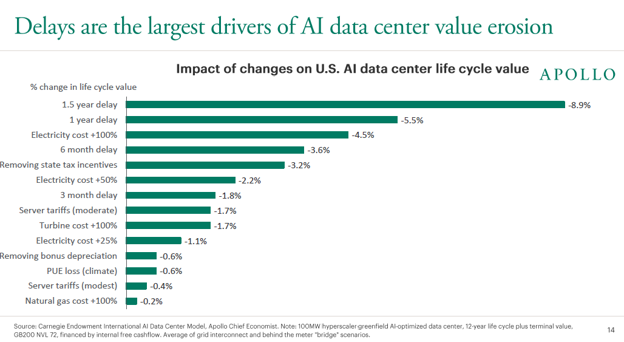
Thus, as always, U.S. corporate ingenuity will continue to adapt and push forward quickly in order eliminate or significantly mitigate this headwind. We've already seen it with Nvidia repurposing obsolete telco buildings, which will avoid many of the regulatory hurdles associated with building new data centers.
Lastly, positive impact on the net present value of future cash flows within the AI opportunity is too large and important to be derailed. So, it remains unchanged following the midterms.
While there may be some change in speed in the short term, AI’s upside benefits over the next few years are so large that stopping at this point would be more difficult than trying to turn a freightliner 90 degrees to the right or the left. But don’t believe us, look at the consensus expectation of these companies’ massive acceleration in free cash flow:
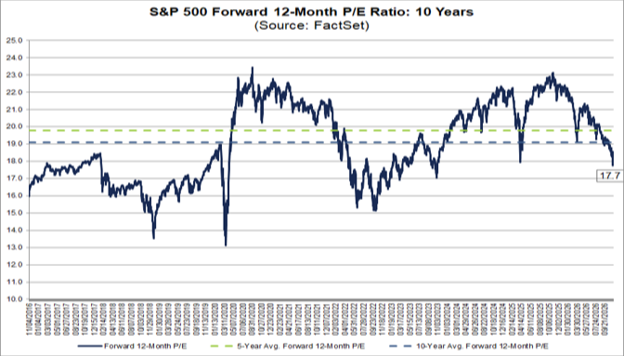
If that profitability isn't enough fundamental support, the cherry on top is that these companies are also on sale, sitting at their cheapest valuations in recent history. The current forward 12-month price-earnings ratio for the S&P 500 is 17.7 times, which is lower than both the five- and 10-year averages:
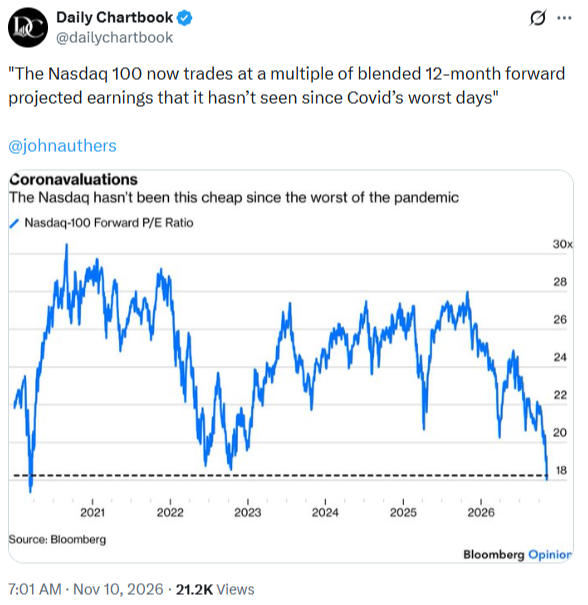
Additionally, in the tech-focused Nasdaq 100, the forward 12-month P/E ratio sits between 18 times and 19 times, which is the cheapest valuation since the COVID pandemic:
This forward P/E compression is a direct result of exploding earnings over the past few quarters. It’s resulted in a recent historical record divergence between per-share earnings and market prices:
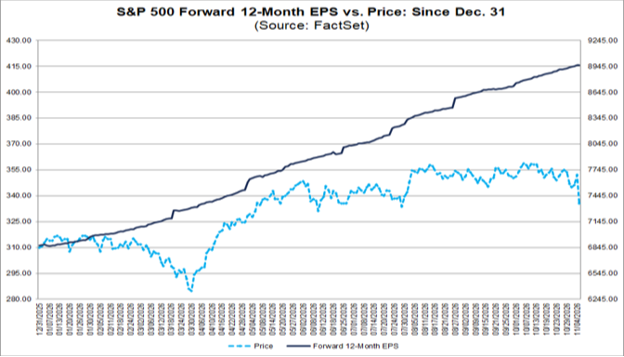
We know that gap cannot and will not remain that significant over time as prices inevitably catch up with fundamental earnings.
This is why, historically, every time the Nasdaq 100 has dropped over 4.5% or more while MoneyFlows’s trusty Big Money Index was also below 50%, market prices were higher a year later:
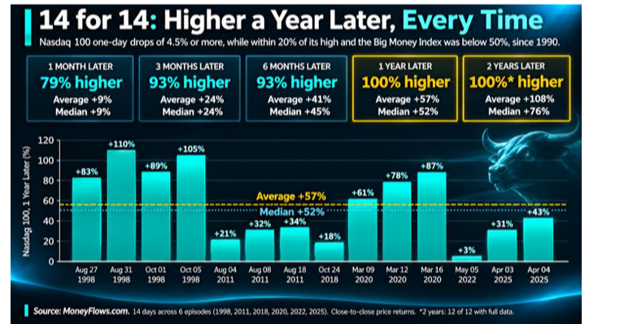
That’s 14 for 14 – a 100% hit rate – exemplifying how the opportunity in “crisis” can beat the perceived danger every day of the week.
*Links to third-party websites are being provided for informational purposes only. CoreCap is not affiliated with and does not endorse, authorize, or sponsor any of the listed websites or their respective sponsors. CoreCap is not responsible for the content of any third-party website or the collection or use of information regarding any websites users and/or members.
*Past performance does not guarantee future results.
Securities sold through CoreCap Investments, LLC. Advisory services offered by CoreCap Advisors, LLC. Cornerstone Financial and CoreCap are separate and unaffiliated entities.